
PVC & Vinyl Fencing
A Low-Maintenance Option for a Beautiful, High-Quality Fence
Steadfast Fencing, Decking & Construction installs PVC and vinyl fencing for homeowners throughout the Portland Metro area. We help you compare materials, styles, maintenance requirements, and long-term value so you can choose a fence that fits your property and priorities.
Privacy Without All the Upkeep
A cedar fence can be beautiful, but natural wood requires ongoing care. Over time, moisture, weather exposure, and normal aging can lead to fading, splitting, warping, and other maintenance needs. Staining and sealing also become part of long-term ownership.
PVC fencing offers another option. This manufactured fence material is designed to provide lasting privacy and durability with significantly less routine maintenance than traditional wood.
PVC can be especially appealing if you want:
- Strong backyard privacy
- Less ongoing maintenance
- Moisture-resistant materials
- A clean and consistent appearance
- No routine staining or sealing
- An alternative to traditional cedar fencing


Why Portland Homeowners Choose PVC Fencing
Less Routine Maintenance
PVC fencing doesn’t require the regular staining or sealing that most wood fences do.
Excellent Moisture Resistance
These materials are designed to handle moisture differently than natural lumber, making them especially worth considering in the Pacific Northwest.
Strong Backyard Privacy
Solid-panel systems can create excellent privacy around backyards, patios, outdoor living spaces, pools, side yards, and property boundaries.
No Splintering Wood
No rough edges or splinters can be especially appealing for households with children, pets, or heavily used yards.
Consistent Appearance
PVC fencing provide a more uniform appearance than natural lumber.
Composite vs. PVC and Vinyl Fencing: What’s the Difference?
The terminology around low-maintenance fencing can get confusing. Here is the practical difference.
PVC and Vinyl Fencing
A cedar fence can be beautiful, but natural wood requires ongoing care. Over time, moisture, weather exposure, and normal aging can lead to fading, splitting, warping, and other maintenance needs. Staining and sealing also become part of long-term ownership.
PVC fencing offers another option. This manufactured fence material is designed to provide lasting privacy and durability with significantly less routine maintenance than traditional wood.
PVC can be especially appealing if you want:
- Strong backyard privacy
- Less ongoing maintenance
- Moisture-resistant materials
- A clean and consistent appearance
- No routine staining or sealing
- An alternative to traditional cedar fencing
Composite Fencing
Composite fencing is manufactured from a blend of different materials rather than solid natural lumber. Depending on the product, composite fencing may offer a denser or more substantial appearance than a traditional vinyl while maintaining many of all the same low-maintenance advantages
Composite fencing can be especially appealing when you want:
- Full backyard privacy
- Reduced maintenance
- Moisture resistance
- A more wood-inspired appearance
- A durable alternative to traditional wood fencing
PVC & Vinyl Fence Styles
Low-maintenance fencing can solve several different needs around your property.
PVC Privacy Fencing
Solid PVC fencing creates strong visual separation while avoiding the routine refinishing associated with natural wood.
It can be an excellent option for:
✓ Backyard privacy
✓ Close neighboring properties
✓ Side yards
✓ Outdoor living spaces
✓ Homes where low maintenance is a priority
PVC privacy fencing works particularly well when you want the function of a traditional privacy fence without the maintenance requirements of cedar.
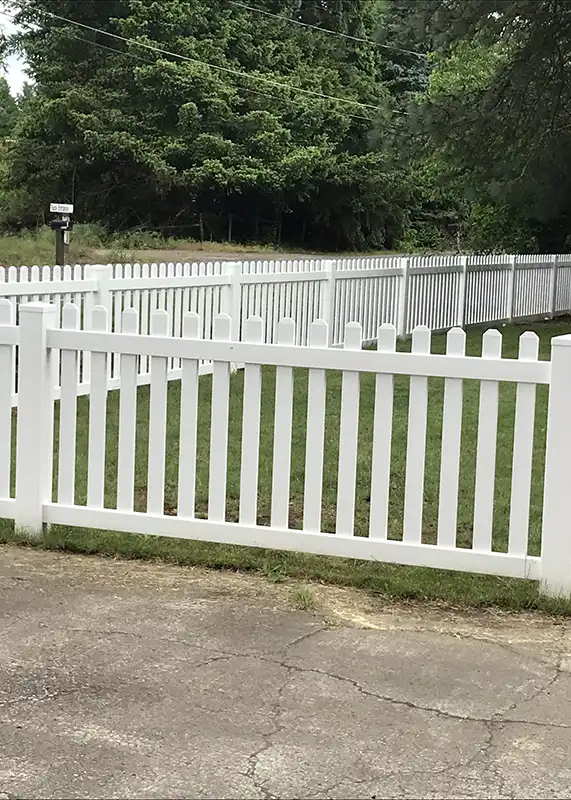
PVC Picket Fencing
Not every fence needs to block the view.
PVC picket fencing can define a front yard, garden, or property boundary while maintaining an open and welcoming appearance.
It can provide the familiar look of a traditional picket fence without the routine painting, staining, or sealing associated with wood.
Open-Rail PVC Fencing
Two-rail and three-rail PVC fencing can work well when the goal is to define a property without creating a solid visual barrier.
✓ Larger residential properties
✓ Landscaped areas
✓ Traditional home styles
✓ Decorative boundaries
✓ Properties where openness matters more than privacy
Matching Gates
A gate should be designed as part of the fence, not added as an afterthought.
We consider:
✓ Gate width
✓ Placement
✓ Support
✓ Hardware
✓ Daily use
✓ Alignment
✓ Long-term operation
Honest Comparison
When Cedar or Metal May Make More Sense
Consider Cedar When...
You want the warmth and character of natural wood. The tradeoff is maintenance. Wood naturally changes over time and generally requires more ongoing care than PVC fencing.
Consider Ornamental Metal When...
You want security or boundary definition without blocking the view. Ornamental metal can work especially well for properties where visibility matters.
Consider Chain Link When...
Function and budget are the primary priorities. Chain link can provide durable containment and property definition without the cost or visual weight of a solid privacy fence.
Fence Material Comparision Chart
| Priority | PVC / Vinyl | Cedar | Ornamental Metal |
|---|---|---|---|
| Low maintenance | Excellent | Requires more upkeep | Excellent |
| Natural appearance | More uniform appearance | Excellent | Distinct architectural appearance |
| Full privacy | Excellent | Excellent | Limited |
| Design flexibility | Good | Excellent | Good |
| Moisture resistance | Excellent | Depends on maintenance and design | Excellent with appropriate finish |
| Routine staining required | No | Typically yes | No |
| Open views | Limited | Possible | Excellent |
| Best fit | Easy-care privacy and boundaries | Natural custom fencing | Open security and definition |

Local Conditions
Built for Pacific Northwest Conditions
These may include:
✓ Wet soil
✓ Drainage
✓ Sloped yards
✓ Wind exposure
✓ Seasonal ground movement
✓ Uneven fence lines
✓ Limited access
✓ Existing landscaping
✓ Gate placement
✓ Neighboring structures
A Low-Maintenance Fence Still Needs High-Quality Installation
PVC fencing may require less maintenance after installation, but that does not make craftsmanship less important. It makes proper installation even more important.
A durable fence still depends on:
Proper Post Layout
Clean Alignment
Thoughtful Slope Transitions
Properly Supported Gates
Product-Appropriate Installation
Proven Experience. Reliable Results.
Why Choose Steadfast?
We Help You Choose the Right Material
We install several types of fencing, including cedar, composite, PVC, chain link, and ornamental metal. That means our recommendation can begin with your property and priorities instead of trying to make one product fit every project.
We Understand Pacific Northwest Properties
Rain is only part of the equation. We consider terrain, drainage, access, soil conditions, slope, exposure, and the way the fence interacts with the rest of your property.
We Focus on the Details That Affect Long-Term Performance
Posts, alignment, gates, transitions, hardware, and structural support all matter. We believe quality is found in the details that are easy to overlook and difficult to correct later.
You Get Clear Guidance
We explain the practical advantages and tradeoffs of different materials so you can make an informed decision. If cedar makes more sense for your project, we will tell you. If PVC or composite is the better fit, we will explain why.
You Get a Clearly Defined Scope
We evaluate the property before defining the project so your estimate reflects the actual conditions and work required.
Communication Is Part of the Job
You should not have to chase your contractor for basic information. We keep communication straightforward from the first conversation through the final walkthrough.
We Understand the Bigger Outdoor Living Picture
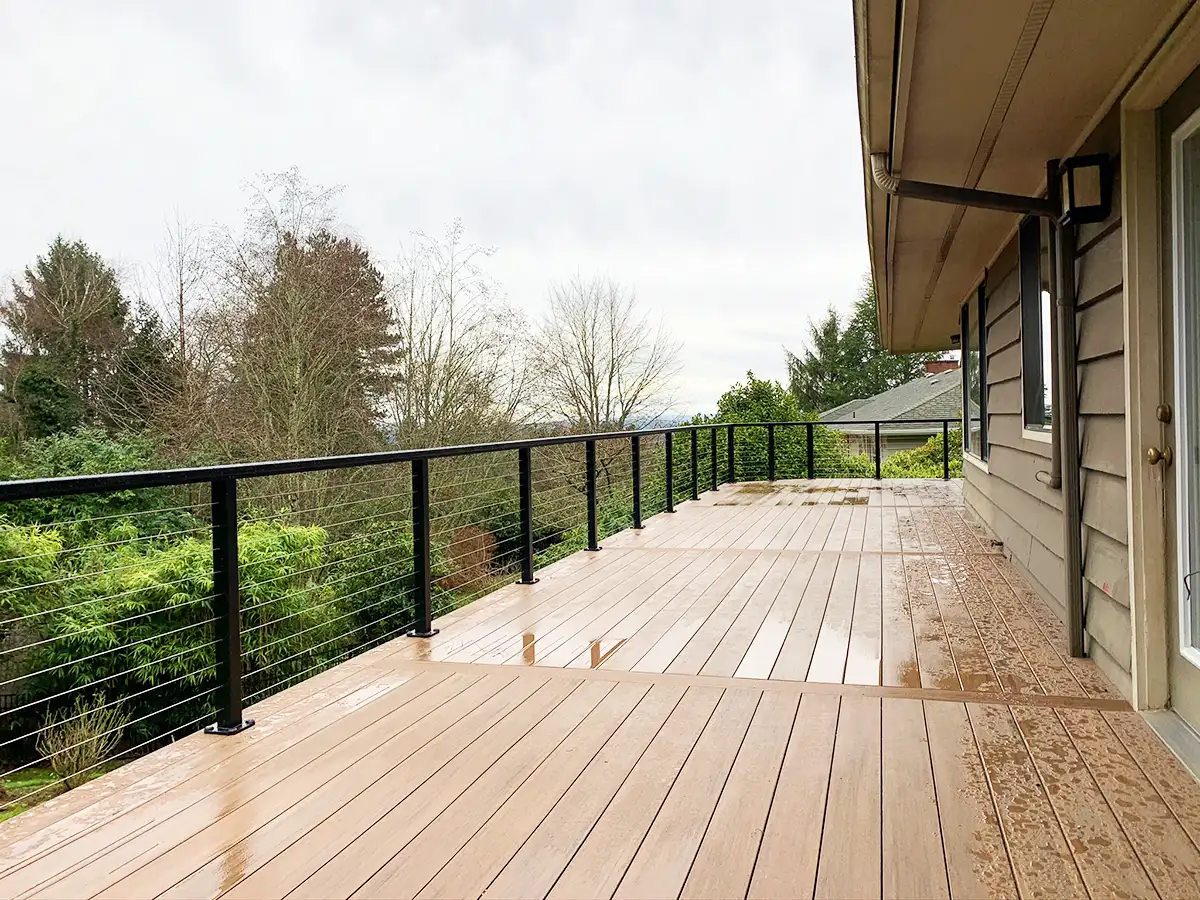
Steadfast also builds decks, railings, patio covers, pergolas, and other outdoor structures. That broader construction experience helps us think about how your fence works with the rest of your property, especially when fencing needs to connect with a deck, gate, patio, or future outdoor improvement.
Pricing & Estimates
How Much Does PVC Fencing Cost?
There is no one-price-fits-all answer. Two fences with the same linear footage can require very different levels of labor and materials. PVC can require a higher initial investment than some traditional fence options.
The more useful comparison is often long-term ownership. A fence that requires routine staining, sealing, or refinishing has different long-term costs than one that primarily requires occasional cleaning.
We provide free on-site estimates so you can compare realistic options for your property.
Factors that may affect the final price include:
- Material and product selected
- Total linear footage
- Fence height
- Privacy or open design
- Number and size of gates
- Property access
- Slopes
- Existing fence removal
- Soil and installation conditions
- Structural requirements
- Custom details
Our Fence Installation Process
1. We Visit the Property
We review the fence line, terrain, access, existing conditions, and how the space is used.
2. We Learn What Matters to You
Privacy, pets, appearance, maintenance, security, and budget can all lead to different recommendations.
3. We Compare Practical Options
If several materials could work, we explain the advantages and tradeoffs so you can make an informed choice.
4. We Define the Scope
Your estimate outlines the proposed work and what is included.
5. We Build With Care
Our team focuses on accurate installation, clean details, and respect for your home and property.
6. We Review the Finished Project
Before the project is complete, we check the fence, gates, alignment, and finishing details against the agreed scope.
Frequently Asked Questions
Is PVC fencing the same as vinyl fencing?
In residential fencing, the terms PVC and vinyl are commonly used interchangeably. PVC is the material used to manufacture most vinyl fence systems. Specific products, construction methods, and finishes vary by manufacturer.
Is PVC fencing only available in white?
It can be. Initial material and installation costs vary by product and project. Cedar also comes with ongoing maintenance considerations, so it is helpful to compare both upfront cost and expected upkeep.
Is PVC more expensive than cedar?
It can be. Initial material and installation costs vary by product and project. Cedar also comes with ongoing maintenance considerations, so it is helpful to compare both upfront cost and expected upkeep.
Does PVC fencing require maintenance?
PVC fencing requires much less routine maintenance than most wood fencing, but no outdoor structure should be considered completely maintenance-free. Occasional cleaning may be needed to remove dirt, moss, organic buildup, and other surface debris.
Can PVC fencing provide full privacy?
Yes. Many PVC systems are specifically designed for full privacy using solid or tightly fitted panels.
Can PVC fencing be installed on a sloped yard?
Often, yes. The right installation method depends on the fence system and the amount of grade change. We evaluate slope conditions during the site visit before recommending an approach.
Can you install matching gates?
Yes. Gate placement, width, hardware, and structural support can be incorporated into the fence design so the gate works properly and looks like part of the finished system.
Is PVC fencing a good idea for a home with pets?
It can be. The best fence for pets depends on the animal, fence height, gate security, openings, yard layout, and level of containment required. We can help you compare PVC, cedar, chain link, and metal options based on your household.
Should I replace my cedar fence with PVC?
Possibly. If reducing future staining and maintenance is one of the main reasons you are replacing the fence, PVC deserves serious consideration. If natural wood appearance and custom design flexibility matter more, cedar may still be the better choice. We can discuss both options during your estimate.
How do I choose between PVC, cedar, and metal fencing?
Start with your priorities. Think about privacy, appearance, maintenance, budget, security, pets, views, property conditions, and how long you expect to own the home. You do not need to make the material decision before contacting us. That is part of what we help you figure out.
What does PVC stand for?
PVC stands for polyvinyl chloride.